Table Clock Guide: Desk, Bedside and Carriage Clocks Worth Owning
Desk, bedside and carriage clocks explained, with tips on silent movements, materials, alarms and choosing a table clock as a gift.
In this article
A table clock is the clock you actually look at most: on your desk during the workday, on the nightstand when the alarm goes off, on a side table in the den. Because it lives at arm’s length, details matter more than with a clock on the wall. In this guide we cover the main types, how to choose a quiet movement, what materials to look for, and how to pick a table clock that makes a lasting gift.
What Counts as a Table Clock
A table clock is any freestanding clock small enough to sit on a desk, nightstand, side table or shelf. The category overlaps with mantel clocks, but table clocks are generally more compact and practical, and they are often chosen as much for function (an alarm, a clear dial, a quiet movement) as for looks.
The main families are:
- Desk clocks, designed for an office or study, often with a clear dial and a weighted base.
- Bedside clocks, which prioritize silence, readable night displays and an alarm.
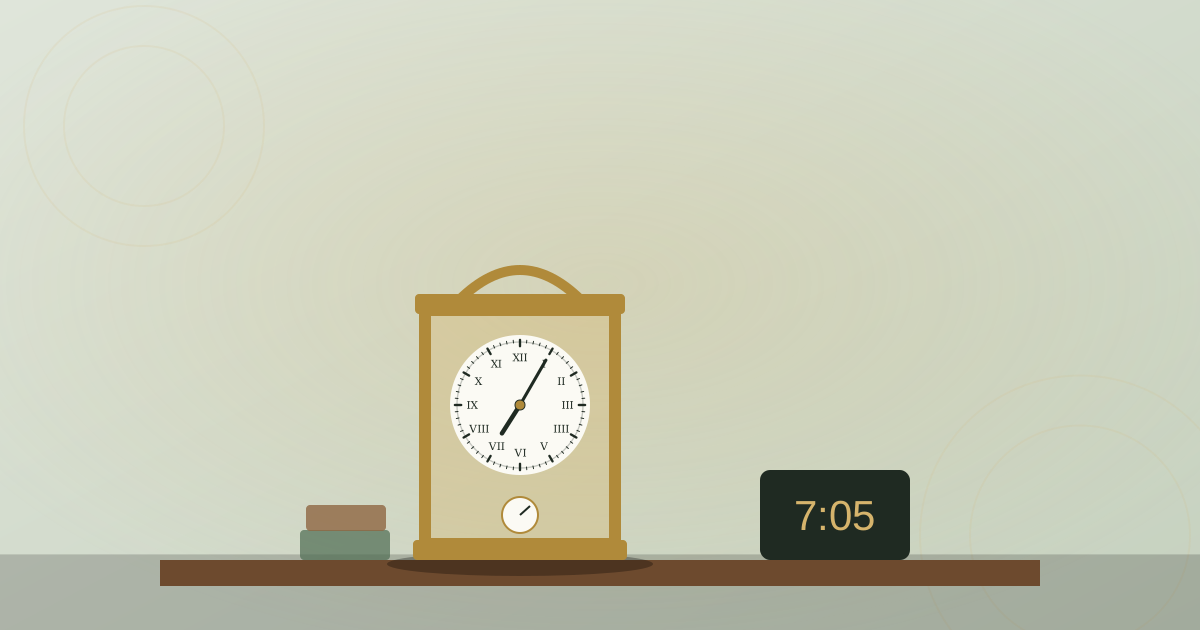
- Carriage clocks, small brass and glass clocks with a top handle, originally made for travel.
- Decorative accent clocks, chosen mainly to complement a room.
If you are after something larger with a chime to anchor a fireplace or sideboard, see our mantel clock guide, which covers tambour, bracket and Art Deco styles.
Carriage Clocks: The Classic Table Clock
Carriage clocks were developed in France in the 19th century as portable clocks for travellers. A typical example has a brass frame, bevelled glass on the sides and top, and a folding handle. Many let you see the balance and movement through the top glass, which is part of their charm.
Mechanical or quartz?
Traditional carriage clocks use a spring-driven movement with a balance wheel, not a pendulum, which is what made them portable. Some have a strike or a repeat button that sounds the last hour. Modern versions are often quartz, which keeps the look while removing winding and servicing.
What to check on an older carriage clock
- Does it run for the full wind (often eight days)?
- Is the glass intact and properly seated in the frame?
- Does the handle fold smoothly without loose pins?
- Is there an original or well-fitting key?
A vintage carriage clock in good working order makes a handsome desk piece, and its compact size means it is easy to ship carefully across Canada.
Choosing a Quiet Movement for the Bedside
Few things are more annoying at night than a loud tick. If the clock is going in a bedroom, the movement is the first thing to check.
| Movement | Sound | Power | Best for |
|---|---|---|---|
| Quartz step | Audible tick | Battery | Desks, kitchens |
| Quartz sweep | Near silent | Battery | Bedrooms, nurseries |
| Radio-controlled | Varies | Battery | Set-and-forget accuracy |
| Mechanical (balance) | Steady tick | Wound spring | Studies, collectors |
| Digital | Silent | Battery or mains | Bedside alarms |
A sweep (or continuous) movement moves the second hand smoothly instead of jumping once per second, which removes most of the tick. Product listings often describe these as “silent” or “non-ticking.” Radio-controlled clocks set themselves from a time signal, and some models can pick up signals in parts of Canada, though reception depends on your location and the clock’s design. Check the specifications before relying on it.
Alarm features worth looking for
- A gradual or crescendo alarm that starts softly.
- A snooze button large enough to find in the dark.
- A backlight or illuminated hands that do not glow too brightly.
- A simple way to turn the alarm on and off without resetting it.
For a mechanical bedside clock, remember that the tick is part of the experience. Some people find it soothing; others cannot sleep with it. If you share a room, it is worth testing first.
Materials and Finish
Because a table clock is seen and handled up close, materials and finish make a big difference to how it feels.
- Brass is classic for carriage clocks and traditional desk clocks. Lacquered brass resists tarnish; unlacquered brass develops a warm patina.
- Wood suits studies and traditional bedrooms. Solid wood and good veneers age well, though very dry winter air can cause shrinkage, so keep wooden clocks away from heating vents.
- Marble and stone feel substantial and stay put on a desk, but they are heavy to ship.
- Metal and glass suit modern offices and condos.
- Acrylic and plastic are lightweight and affordable, a good match for children’s rooms or travel.
Look at the dial as well. A clean dial with clear hour markers is easier to read at a glance. Roman numerals add a traditional touch; if you are curious about why so many clocks use them (and why four is often shown as IIII), we explain it in our article on the Roman numeral clock.
Sizing and Placement
A table clock should be readable from where you sit or lie without dominating the surface.
- Desk: a dial of roughly 7 to 12 cm (3 to 5 in) is usually easy to read at arm’s length.
- Nightstand: choose a size you can read without your glasses if possible, and a low-glare face.
- Side table or shelf: you can go a little larger, since it will be read from across the room.
- Level surface: mechanical clocks run best on a firm, level spot.
- Away from sun and heat: direct sun fades dials and finishes; radiators and vents dry out wood.
If you want something for a wall instead, our overview of buying wall clocks in Canada covers the options, from quartz and radio-controlled to mechanical.
Table Clocks as Gifts
A good table clock is one of the most traditional and practical gifts there is. It is useful every day, and a well-made one can last for decades.
Retirement gifts
Clocks have long been associated with retirement, and a quality desk or carriage clock remains a thoughtful choice. Brass carriage clocks and wooden desk clocks with an engraved plate are classic options. Keep the message short: a name, a date and a few words.
Graduation gifts
For graduates heading to university, college or a first job, a smart desk clock or a reliable alarm clock is practical and personal. A compact, quiet model suits a dorm room or shared apartment.
Weddings, anniversaries and milestones
A carriage clock or an elegant table clock with an engraved inscription marks a date in a lasting way. For something more eye-catching, our list of unique wall clocks in Canada has ideas for statement pieces.
| Occasion | Good choice | Engraving idea |
|---|---|---|
| Retirement | Brass carriage clock | Name and years of service |
| Graduation | Desk or alarm clock | Name and year |
| Wedding | Elegant table clock | Couple’s names and date |
| Anniversary | Wood or brass clock | Date and a short phrase |
Prices vary widely by material and movement. A good quartz table clock can be quite affordable, while a mechanical carriage clock typically costs more, roughly from a couple of hundred to over a thousand dollars CAD depending on quality and age. When ordering from outside Canada, allow for shipping time and possible duties.
Care and Upkeep
Table clocks need little care, but a few habits help.
- Replace batteries in quartz clocks about once a year, or when the clock starts losing time. Remove dead batteries promptly to avoid leaks.
- Wind mechanical clocks on a regular schedule and stop at firm resistance.
- Dust gently with a soft, dry cloth. Avoid household sprays on brass and dials.
- Have mechanical clocks serviced every few years by a clockmaker. A local NAWCC chapter in Canada can help you find one.
- Carry carriage clocks by the handle, and avoid jolting them while running.
Final Thoughts: Choosing a Table Clock You Will Use Every Day
Think first about where the table clock will live. For a bedroom, put a silent sweep movement and a gentle alarm at the top of the list. For a desk, focus on a readable dial and a material you enjoy looking at. For a gift, a carriage clock or a well-made desk clock with a short engraving is hard to beat. Pick for daily use first and style second, and you will end up with a clock that earns its spot.
Frequently Asked Questions
What is the difference between a table clock and a mantel clock?
The terms overlap, but a table clock is usually smaller and designed for a desk, nightstand or side table. A mantel clock tends to be larger and more decorative, often with a chime. Many small clocks are sold under both names.
Why is my bedside clock ticking so loudly at night?
Most inexpensive quartz clocks use a step movement that moves the second hand once per second, which produces a tick. A sweep or continuous movement moves the hand smoothly and is much quieter. Swapping to a clock with a sweep movement is usually the simplest fix.
Can a table clock be engraved as a gift?
Many clocks have a brass plate, base or back panel that can be engraved. Ask the retailer before buying, or take the clock to a local engraver. Keep the text short so it fits neatly and stays legible.
Do mechanical carriage clocks need special care?
They need regular winding, a stable spot away from heat and direct sun, and periodic servicing by a clockmaker. Use the handle when carrying, and avoid knocking the clock while it is running. A soft, dry cloth is best for brass and glass.